
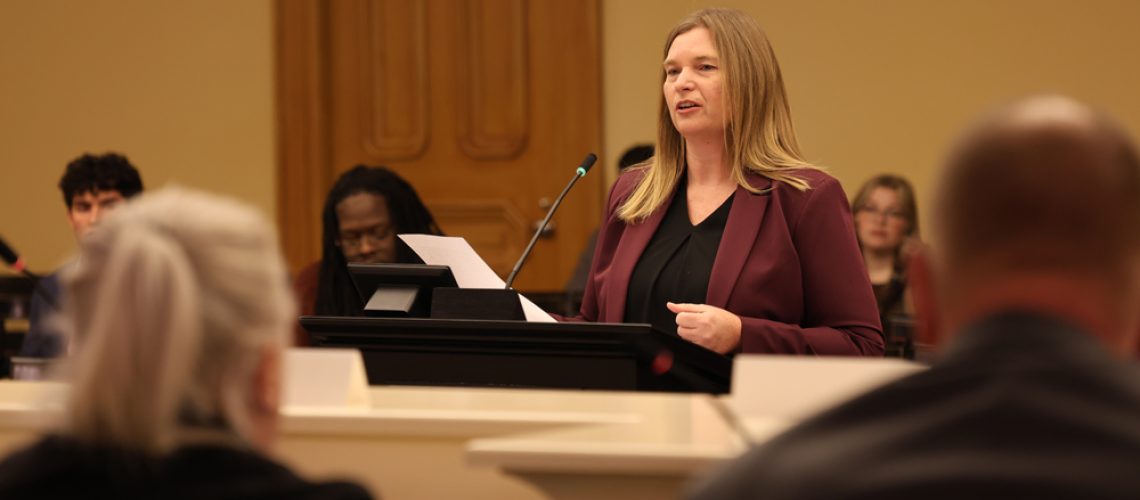

Shelby Cully, director of Disproportionality Reduction, Training, and Quality Assurance (DRTQA) testified before an Ohio legislative study committee in November, advocating for more appropriate placement settings for youth who have been found delinquent by a juvenile court judge.
Youth who are adjudicated delinquent can be placed in the custody of a public children service agency (PCSA) as a disposition alternative to detention. These custody orders often result in the youth being sent to a residential group home when a more appropriate setting should be provided. Currently none exists under state policy or law.
In essence, agencies like Lucas County Children Services can be utilized to assume the care and custody of youth found to be delinquent, even when the case has nothing to do with child abuse or neglect.
LCCS and similar agencies also must assume the steep expense of that care, which can range from $300 to $800 per day per youth from Lucas County Children Services and even more for other PCSAs. For example, Scioto County pays $1500 per day for one of their youth. According to Ms. Cully, the average cost of care is $500 per day per youth, a burden which falls on local taxpayers, as those costs may not be reimbursable at the state or federal level .
“We really want to give the juvenile justice system alternatives to (child protective system) custody,” Ms. Cully said. “The treatment level is often not appropriate in a group home for a child adjudicated delinquent. Treatment for these youth needs to be intensive, individualized, and in the family home. There are services out there that can help. The family needs support, and the cost we’re (currently) paying per day for youth in agency custody could be going for that treatment.”
Ms. Cully testified that the result of using PCSA custody as a disposition alternative in delinquency matters often falls short of the rehabilitative purpose of the juvenile court. It has also lead to an expensive and complicated problem which requires a solution from the state level, as local child protective agencies are being crippled financially by a cost and liability not of their making.
The study committee is the result of a bill passed a couple of years ago seeking to improve the experience of youth placed in group homes. Neighbors of such facilities and local law enforcement complained that teens found to be delinquent were disrupting the safety and peace of surrounding neighborhoods and may commit additional crimes without fear of reprisal.
“Children services is not equipped to handle youth who are a point where they have violent or sexual offending behaviors,” Ms. Cully noted. “Once a child has gotten to the level where they are a threat to their family, and the court says it’s not safe for them to be in their family home, we ask the court then how is it safe for them to be in a foster home?”
Because the needs of each individual child caught in this web are different, there may not be a blanket solution to be found. But other local child protective leaders from across Ohio joined LCCS in testifying for the state to provide the flexible tools necessary to better handle each situation in the best interests of individual children.
There is local representation on the study committee committed to helping LCCS propose solutions to the complicated dilemma. The committee is co-chaired by Sen. Theresa Gavarone (R-Bowling Green). Rep. Erika White (D-Lucas County) also sits on the panel.
“(They) recognize this is an enormous, complex problem that the state needs to pay attention to,” noted Ms. Cully, who plans to work in the coming weeks with Rep. White to offer the study committee workable solutions.
However, adding to the challenge to craft a solution is the fact that the Ohio legislature is in a lame-duck session, which means any policy or legislative recommendations from the study committee must be made by the end of this year. There’s also no guarantee that a new governor and legislature will even act on those recommendations when taking office in January, leaving any potential solutions in limbo.